
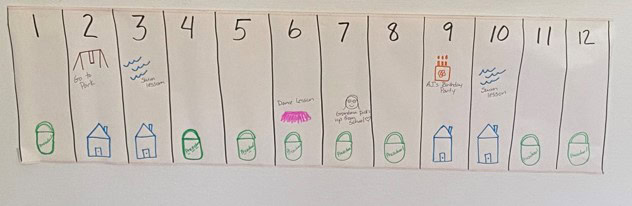
When our daughter was two, my husband had to go overseas for work for several months. It was a long time for him to be away, and during that stretch, we had very limited contact. It was tough on all of us, but especially for our daughter who did not yet understand the context of time for such a long trip. One of the most helpful tools I used to support her during this time was a visual schedule, also called a horizontal calendar. It made a huge difference for her… and for me, too.
I used paper and markers to create a calendar that had the days lined up in one long row. I taped the schedule to the wall at her eye level, added pictures to represent upcoming events, and we marked off days as they passed. It became a comforting part of our daily routine. It was a way for her to keep track of what was coming next in our schedule and as a result she felt more grounded and in control. In a time when so much felt uncertain, this simple schedule gave her a sense of security and helped her world feel more predictable.

Why Young Children Need Visual Structure—Especially During Stress or Trauma
Young children thrive on structure and predictability, especially when life feels overwhelming. During times of trauma like a family crisis, a move, a separation, or a natural disaster, routines are often disrupted. This can leave children feeling confused, anxious, or out of control.
That’s where a visual schedule becomes a powerful support tool. It gives children a way to see time, track their routine, and feel safe knowing what is coming next.
What Is a Visual Weekly Schedule or Horizontal Calendar?
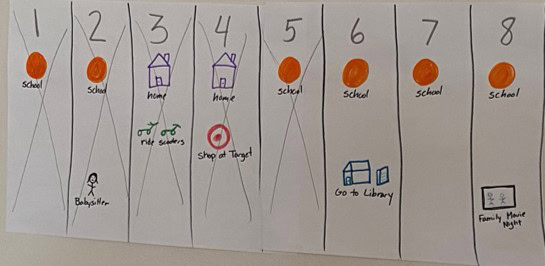
A horizontal calendar displays the days of the week laid out in a straight line from left to right, like a timeline. Instead of using a traditional vertical grid (like a monthly calendar), a horizontal calendar arranges events in a linear, left-to-right format, which mirrors how young children naturally understand and process time, as a sequence of events.
Each day is labeled with pictures or simple words that represent activities, like a backpack for school, a house for home, or a heart for family time.
This type of calendar display makes it easier for kids to:
- Understand the passage of time
- Anticipate what’s coming next
- Feel more in control when the world feels unpredictable
Why Horizontal Calendars Work Best
Most traditional calendars are vertical or monthly grids, great for adults, and confusing for kids. Here’s why a horizontal layout is better for young children:
- They Match How Kids Think
- Young children are concrete thinkers. They live in the now, and the concepts of “next week,” “tomorrow,” or even “later today” can be vague and confusing. Traumatic events can increase this confusion with added disruption to routines and other changes, that make it more difficult for children to predict what is happening next. – A horizontal calendar helps translate the abstract idea of time into something that children can see and understand.
- They’re Easy to Understand
- Children can easily look from left to right to find today what’s next, and how many days until a special event. If you’re going to the pool on Wednesday, you can draw a swimsuit or pool icon and count together: “There are two more school days, then we go to the pool!”
- They Support Emotional Regulation
- When trauma or change disrupts routines, children can feel lost. A clear, visual schedule helps anchor them. It says, here’s what’s happening. You’re safe. We have a plan. That predictability is calming.
How to Use a Visual Weekly Schedule or Calendar with Young Children
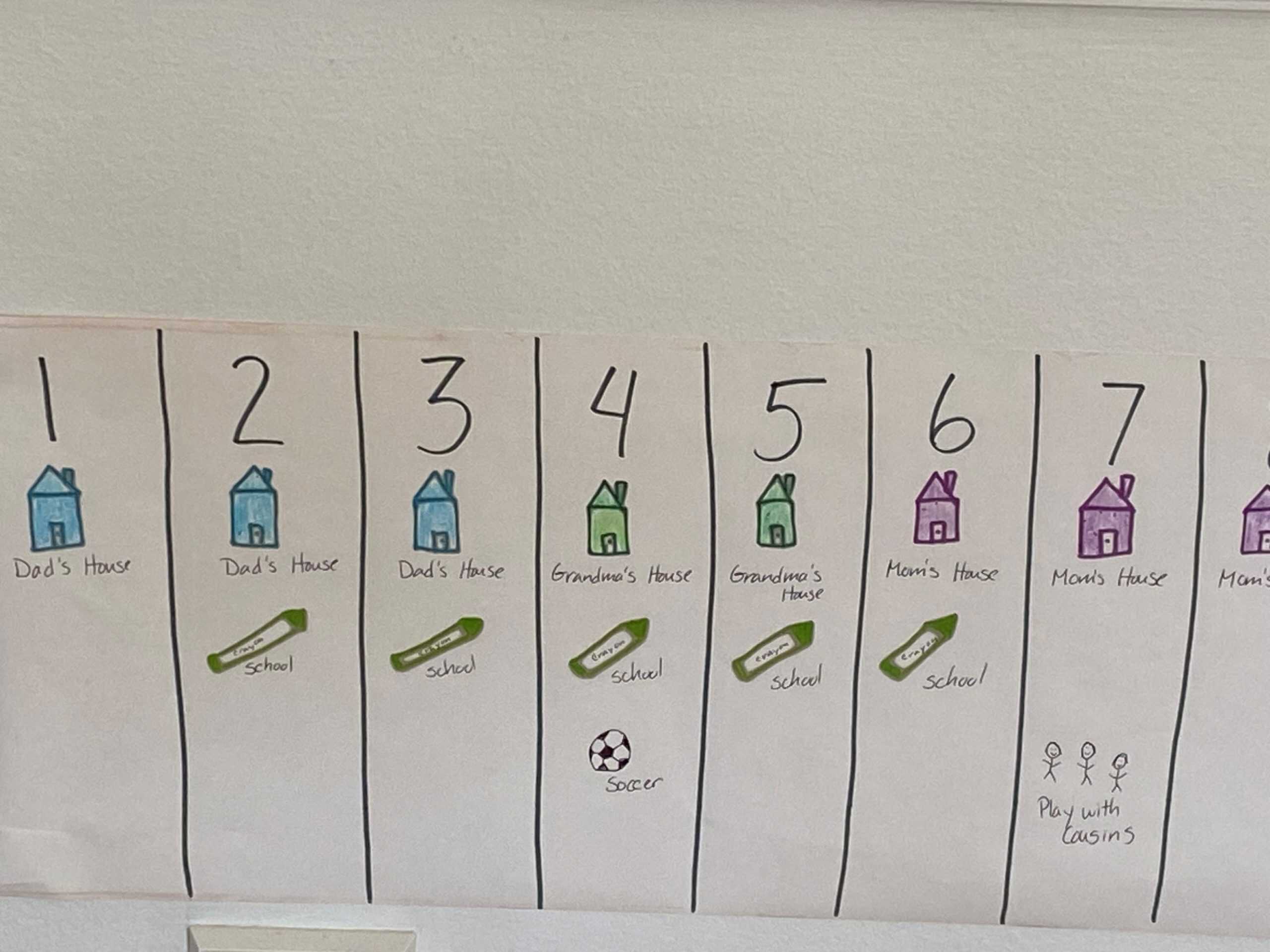
You don’t need fancy materials, just some paper and markers. Here’s how to set it up:
- Create a Simple Weekly or Monthly Strip
- Draw or print out the days of the week horizontally. Do not worry about making it pretty or Instagram worthy. The important thing is to just do it. 😊
- Use symbols or pictures for each day’s main events (e.g., school, playdates, family dinner, etc.). Be sure to use the same picture for repeating events. For example, use the same symbol or picture for school every time you put it on the calendar.
- Be sure to hang it at eye level for your child or class.
- Involve your Child
Let your child help choose the pictures or color the boxes. This gives them a sense of ownership.
- Clearly Mark the Current Day
In the morning, you can move a “Today” marker (like a clothespin) to the current day. You can also mark off the day with a crayon or pen at the end of the day.
4. Reassure Through Repetition
In trauma, kids often ask the same questions repeatedly. A horizontal calendar helps you answer those questions visually:
“Yes, Daddy picks you up on Friday. See? Here’s Friday with Daddy’s picture.”
Supporting Trauma Recovery Through Predictability
A horizontal calendar offers more than just a schedule. It says:
- There is order, even when things feel chaotic.
- You can trust what’s coming next.
- You are safe.
This serves as more than just a calendar; it becomes a form of emotional support.

Final Thoughts
The horizontal calendar was an amazing support for our daughter when my husband was away. I would find her looking at the calendar and reviewing our schedule on her own throughout the day. It was great for me to have a tool to reference with her when we talked about upcoming events and how long it would be before daddy got home. The calendar was so successful that we kept it going long after my husband returned from his trip.

Sarah Grissom – U4C Education Specialist
Sarah Grissom is an Education Specialist at United 4 Children. She develops and provides professional development for early childhood educators. With a master’s degree in early childhood education and a bachelor’s degree in political science she has spent the past 25 years working with and advocating for children and families. She lives in St. Louis with her husband, two children, and dog. She enjoys reading non-fiction and pinning recipes she will never make.
Related Posts
What Families Should Know When Choosing a Safe Child Care Program
Choosing a child care program is one of the most important decisions a family can make. While convenience and cost matter, safety must always come first. A safe, high-quality child care environment does more than prevent harm, it supports children’s development,...

Creating Safe Sleep Environments: A Guide for Early Childhood Educators and Families
Early childhood educators and families share the responsibility of helping infants sleep safely. Consistent safe sleep practices in child care programs and at home reduce the risk of sleep-related incidents, including sudden infant death syndrome (SIDS). When...

Connecting the Dots: Child Safety and the Social Factors That Shape It
We often think about child safety in terms of physical protection by using car seats, safe sleep practices, or close supervision to help prevent injuries. While these are critical, they represent only part of a much broader picture. Child safety best practices are...
